

Last week, I took my family on another outdoor astronomy adventure. My kids are emerging space nerds (like their dad), so it doesn’t take much convincing. 🌌
We’ve been into astronomy for years, but it wasn’t until the pandemic that we found time to regularly dedicate to it. And apparently we’re not alone—backyard astronomy is booming right now!
The pandemic has had many subtle—and interesting—unexpected phenomena.
There are plenty of explanations for this. In the case of stargazing, there is a much lower level of baseline crazy in our lives (eg, less commuting through traffic, overbooking with activities, clubs, sports, playdates, parties).
And second, when we have time off these days, we aren’t planning far away adventures. An adventure to the other coast—let alone anything abroad—is not on our radar.
Right now, most of us are left seeking the places and things that have always been right under our noses. And that’s wonderful.
These surprising pandemic consequences are happening on the veterinary clinic floor, too.
This summer, every conversation seemed to be about our industry’s bizarre busyness and curbside workflows. These days, our conversations seem to be about reflecting on other interesting outcomes and applications for the months ahead.
Here are 3 of those strange pandemic-mode observations that I’ve been talking to practice owners about.
1. Shadowing, Learning From, and Teaching Colleagues 👨🏫
During a busy day in the ER, I’d never find the time to be in exam rooms with my colleagues or have others shadow me when seeing cases.
But there are no exam rooms anymore. So now, for entire shifts, we’re sitting next to each other all day, “seeing” cases via the telephone.
The way we all take histories, recommend care, handle difficult situations, and educate animal owners is on full display!
If you haven’t noticed this yet, I recommend paying attention. It’s likely a temporary phenomena, so don’t miss the opportunity.
Watch and listen to your colleagues: I bet you’ll learn something!
2. Outpatient Workflow, Supercharged ⚡
We thought we were ahead of the efficiency curve before the pandemic. But now we’re supercharging it—particularly with outpatient checklists.
Before the pandemic, there was a semi-chaotic discharge process in the veterinary outpatient setting.
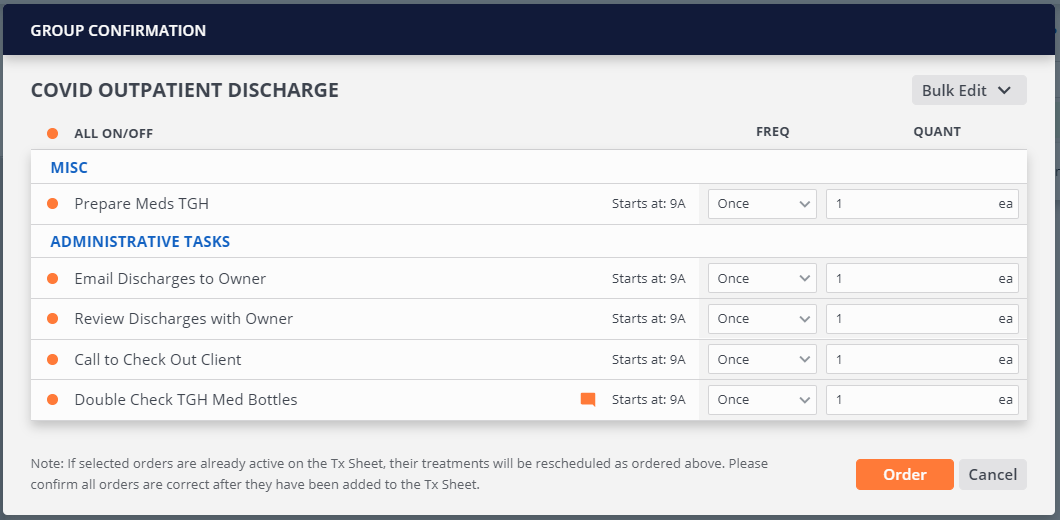
To handle both the added caseload, curbside workflows, and need for consistency, we’ve instituted an Outpatient ER COVID Discharge checklist.
When our clinicians are done with cases, they simply schedule this checklist and move on. The team knows exactly what to do and where things stand, and there’s full documentation and accountability to the whole process.
We’ll never look back!
3. No More Clipboards (Direct to Computer) 💻
I’ve heard this one from several other hospitals as well.
We’ve debated exam room computers for years. Ultimately, we never did it because we believe that typing in front of a pet owner would decrease the client experience, given our current software limitations.
So we’d enter with one of the only pieces of paper left in our hospital workflow: the scrap sheet on a clipboard.
To try to reduce clutter and fomites, many hospitals that had lingering paper like this have finally moved on.
With the pandemic upon us and no more exam rooms, we’re the same and have now fully abandoned our clipboards.
👉 One surprising observation? Clinicians are much faster because of it!
Here are some of the steps that have helped us make this work practically:
- When a patient gets checked in, the front desk team generates a cage card and a neck band and provides them to the triage team.
- Instinct is used to track cases. Clipboards used to double as a workflow tool, helping everyone know what was left to do on a patient. Now, if I haven’t completed paperwork, I personally pin my cases to mimic this workflow.
- We’ve eliminated nurse triage histories unless necessary. Instead, at curbside check-in, we focus on obtaining a clear and concise presenting complaint and entering it immediately into Instinct for easy team-wide communication. Progress notes can also double as a place to put more details on a case-by-case basis.
- Before calling a client to go over the history, clinicians set up their exam form and have it in front of them/ready to type.
It’s safe to say more pandemic phenomena will emerge in the months ahead. And you’ve probably already seen other side effects of the pandemic in your own hospital—some good, some not.
But in this increasingly bizarre time, with as hard as it is to see the good, I’d challenge you to take a look under your nose (or over to the next telephone).
You might be surprised by what you can improve. 🔭
